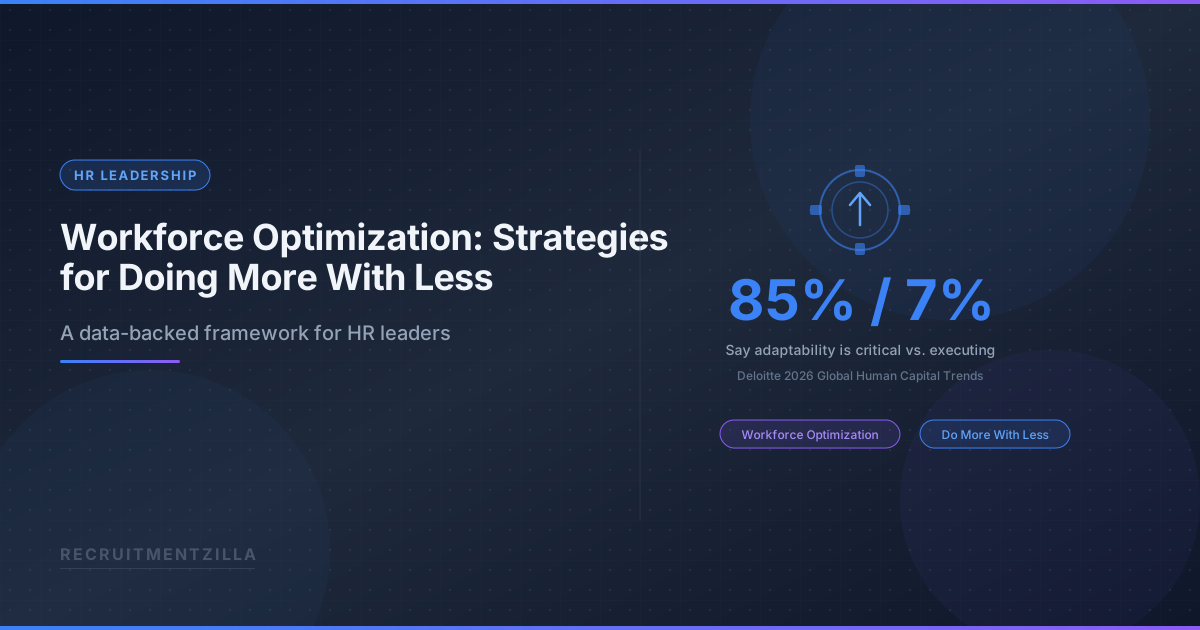
Budget pressures keep rising. Expectations keep climbing. And headcount? Staying flat or shrinking. According to Deloitte’s 2026 Global Human Capital Trends, 85% of business leaders say building workforce adaptability is critical, yet only 7% are actually leading in it. That gap defines the challenge facing every HR leader right now.
This guide delivers a practical, research-backed framework for workforce optimization that increases output without increasing headcount. You’ll find strategies covering skills deployment, technology integration, engagement investment, and measurement, all grounded in data from Gallup, McKinsey, Gartner, and the World Economic Forum.
Key Takeaways
- Workforce optimization aligns people, process, and technology to boost output without growing headcount
- Skills-based organizations are 57% more likely to anticipate change (Deloitte, 2023)
- Start with manager development and skills audits for the highest-ROI, lowest-cost moves
- AI maturity remains at 1%, meaning workflow redesign matters more than new tools
- Engagement investment delivers 18% higher productivity per team
What Is Workforce Optimization and Why Does It Matter Now?
Workforce optimization is the systematic alignment of people, processes, and technology to maximize output per employee. It matters urgently because global employee engagement fell to 20% in 2025, costing the world economy an estimated $10 trillion in lost productivity (Gallup State of the Global Workplace, 2026).
Don’t confuse workforce optimization with workforce management or workforce planning. They’re related but distinct. WFO is the strategic umbrella, while the others sit beneath it.
Meanwhile, 61% of HR professionals cite reducing costs and improving efficiency as a priority, and 48% view budget constraints as a major barrier (SHRM, 2025). The “do more with less” mandate isn’t new, but the convergence of budget pressure, engagement decline, and AI disruption makes it existential.
Why does traditional cost-cutting fail? Because headcount reduction without system redesign produces diminishing returns. You remove people but keep the same broken processes. Output drops faster than costs.
WFO vs. Workforce Management vs. Workforce Planning
| Concept | Scope | Focus | Timeframe |
|---|---|---|---|
| Workforce Optimization | Strategic umbrella | People + process + technology alignment | 1-5 years |
| Workforce Management | Operational subset | Scheduling, time tracking, compliance | Daily/weekly |
| Workforce Planning | Analytical function | Demand forecasting, scenario modeling | 6-24 months |
For more on the planning component, see our workforce planning guide for growing companies.
Citation Capsule: Workforce optimization is the strategic alignment of people, processes, and technology to maximize productivity without growing headcount. Global engagement at 20% costs the world economy $10 trillion annually according to Gallup’s 2026 State of the Global Workplace report.
What Are the Core Pillars of an Effective Workforce Optimization Strategy?
Effective workforce optimization rests on five interconnected pillars: strategic workforce planning, skills-based talent deployment, process automation, engagement investment, and continuous measurement. Deloitte found that 70% of leaders say their primary competitive strategy over the next three years is to be “fast and nimble” (Deloitte 2026 Global Human Capital Trends, 2026).
These pillars don’t work in isolation. Automating a broken process just makes it fail faster. Deploying skills without measuring outcomes produces activity, not progress. Here’s how each pillar contributes.
Pillar 1: Strategic Workforce Planning. Demand forecasting, scenario modeling, and gap analysis form the foundation. Without knowing what capabilities you’ll need in 12-18 months, optimization becomes reactive firefighting.
Pillar 2: Skills-First Deployment. Skills-based organizations are 57% more likely to anticipate change and respond effectively (Deloitte Research cited by WEF, 2023). Instead of fitting people into static job descriptions, you match capabilities to evolving business needs. This means fewer external hires and faster internal redeployment.
Pillar 3: Intelligent Automation. Target repetitive, rules-based work. Leave human judgment, creativity, and relationship-building to humans. The goal isn’t to replace people but to free them for higher-value activities.
Pillar 4: Engagement as a Productivity Lever. Gallup’s meta-analysis shows engaged teams are 18% more productive and 23% more profitable. Engagement isn’t soft. It’s an economic multiplier.
Pillar 5: Measurement and Iteration. What gets measured gets optimized. Build feedback loops with 5-7 metrics tied directly to business outcomes. Review quarterly, adjust continuously.
But which pillar should you tackle first? That depends on your biggest constraint. Budget-strapped teams start with engagement and skills. Tech-ready teams start with automation. We’ve found that most HR functions get the best early wins from pillars 2 and 4, since they cost little and deliver fast.
See our talent management framework for how skills deployment connects to broader strategy.
Citation Capsule: The five pillars of workforce optimization are strategic planning, skills-based deployment, intelligent automation, engagement investment, and measurement. Skills-based organizations are 57% more likely to respond effectively to change according to Deloitte research cited by the World Economic Forum.
How Can AI and Automation Drive Workforce Optimization?
Eighty-eight percent of organizations now use AI in at least one business function, yet only 1% have reached maturity (McKinsey State of AI 2025, 2025). The optimization opportunity isn’t in buying more tools. It’s in redesigning workflows around the tools you already have.
Consider the maturity gap more carefully. Only 1 in 50 AI investments deliver transformational value, and only 1 in 5 deliver any measurable ROI (Gartner via HBR, 2026). Yet 92% of organizations plan to increase AI spending. That’s a recipe for waste unless you change the approach.
Where does AI deliver proven returns in HR? According to SHRM’s survey of 1,908 HR professionals, 85% of employers using automation or AI report time savings and increased efficiency, and 86.1% of recruiters using AI reported it accelerates hiring (SHRM State of AI in HR, 2026). These are real gains, not theoretical.
The Workflow Redesign Principle
McKinsey’s Global Institute found that AI agents and robots could add $2.9 trillion per year to the U.S. economy by 2030, but only if organizations redesign entire workflows rather than automating isolated tasks (McKinsey Global Institute, 2025).
What does workflow redesign look like in practice? Instead of bolting an AI screening tool onto your existing hiring process, you redesign the entire candidate evaluation pipeline. You rethink what information flows where, who makes which decisions, and where AI acts as a “virtual coworker” rather than a point solution.
Practical AI applications that deliver optimization value:
- Scheduling optimization - Algorithmic shift planning that balances coverage, cost, and employee preferences
- Predictive attrition - Identifying flight risks 60-90 days before resignation
- Skills matching - Connecting internal talent to open roles based on capability, not job title
- Automated screening - Filtering high-volume applications while humans focus on final-stage evaluation
Still, 72% of HR professionals say nontechnical barriers block full automation (SHRM, 2026). Culture, change management, and trust remain the harder problems to solve.
For specific tasks to automate first, see our guide on recruitment automation.
Citation Capsule: 88% of organizations use AI but only 1% have reached full maturity. McKinsey found that the $2.9 trillion productivity opportunity requires redesigning entire workflows around AI rather than automating isolated tasks within existing processes.
Why Is Employee Engagement the Most Overlooked Optimization Lever?
Global engagement sits at just 20%, its lowest since 2020, and Gallup estimates this costs the world economy $10 trillion annually in lost productivity (Gallup, 2026). That makes engagement investment the highest-ROI optimization strategy most organizations ignore.
The numbers stack up clearly. Engaged teams are 18% more productive and 23% more profitable according to Gallup’s meta-analysis across hundreds of organizations. Yet most optimization conversations jump straight to technology or headcount, skipping the single biggest productivity driver.
The manager engagement crisis compounds the problem. Manager engagement dropped 9 points since 2022, with managers under 35 and female managers hit hardest. Since managers directly shape team engagement, this creates a cascading failure. Disengaged managers produce disengaged teams, which produce subpar output.
Mercer’s 2026 Global Talent Trends survey of 12,000 respondents found only 44% of employees report thriving at work, down sharply from 66% in 2024 (Mercer, 2026). That’s a 22-percentage-point collapse in two years. Can any efficiency initiative compensate for that kind of decline in human energy?
Why does optimization without engagement backfire? Because efficiency gains get offset by turnover costs, quiet quitting, and presenteeism. You streamline a process only to lose the people who run it. The net effect is often negative.
Practical levers that move engagement without large budgets:
- Manager development - Coaching skills, feedback cadence, and autonomy practices
- Role clarity - Eliminating ambiguity about expectations, decision rights, and success criteria
- Growth paths - Visible career progression tied to skills development
- Autonomy - Trusting teams with how work gets done, not just what gets done
Burnout directly undermines optimization gains. See our guide on recruiter burnout solutions for targeted interventions.
Citation Capsule: Employee engagement at 20% costs the global economy $10 trillion annually. Gallup’s meta-analysis of hundreds of organizations shows engaged teams deliver 18% higher productivity and 23% higher profitability, making engagement investment the highest-ROI optimization lever.
How Do You Build a Skills-First Optimization Framework?
The World Economic Forum reports that 85% of employers plan to prioritize upskilling as their primary workforce strategy through 2030 (WEF Future of Jobs Report, 2025). Skills-based organizations are 57% more likely to anticipate and respond to change (Deloitte, 2023). The evidence is overwhelming: skills-first beats headcount-first for optimization.
Why? Because redeployment costs less than reduction and rebuilding. When you know what your people can do (not just what their job title says), you can shift capacity to where the business needs it. No external hiring costs. No ramp-up time for new hires.
The skills gap remains the primary barrier, though. According to WEF, 63% of employers cite skill gaps as the primary obstacle to business transformation. Closing these gaps through internal upskilling is both the cheapest and most effective path forward.
We’ve found that running a skills audit doesn’t need to be a six-month project. You can map your team’s current capabilities to business goals in a single focused workshop. Start by listing the five capabilities your strategy demands most over the next year. Then ask each team member to self-assess and get manager validation. The gap between “needed” and “available” becomes your development roadmap.
AI fluency serves as the new baseline skill. Demand for AI-related competencies grew 7x in two years (McKinsey). Every role, not just technical ones, will require some level of comfort with AI tools. Building this competency internally is cheaper than hiring for it externally.
From Job-Based Planning to Skills-Based Planning
Traditional job architecture assigns people to boxes. You’re a “Recruiter II” or a “Compensation Analyst.” Skills-based planning flips this model. People hold portfolios of capabilities that can be deployed flexibly across projects, teams, and functions.
This shift enables internal mobility as an optimization lever. Instead of posting a role externally when a need arises, you search your internal skills marketplace for someone who can stretch into it. You reduce time-to-fill, cut costs, and develop your people simultaneously.
Understanding transferable skills in hiring is the foundation of this approach.
Citation Capsule: 85% of employers plan to prioritize upskilling through 2030 according to the World Economic Forum. Organizations that adopt skills-based practices are 57% more likely to anticipate change, making internal mobility and reskilling the most cost-effective optimization levers available.
What Does Workforce Optimization Look Like Under Budget Constraints?
Only 35% of HR leaders plan budget increases in 2025, down from 45% in 2023, while 33% plan cuts. The average HR function spends $2,908 per employee annually (Gartner HR Budget Survey, Dec 2024). That creates real pressure to demonstrate ROI on every dollar spent.
Three consecutive years of declining budget growth means you can’t solve optimization through spending. You need to rethink how work gets structured, prioritized, and measured. In our experience, the organizations that optimize best under budget pressure don’t cut evenly across all activities. They ruthlessly prioritize the few moves that deliver outsized impact.
High-impact, low-cost optimization moves include manager training (often available through existing learning platforms), process audits (zero cost, just time), and internal mobility programs (which reduce external recruiting spend). These don’t require new budget. They require focus and discipline.
Technology rationalization is another often-overlooked opportunity. Most HR teams use 10-15 tools with overlapping capabilities. Before adding anything new, consolidate what you have. One well-configured system beats five poorly adopted ones.
The 29% Productivity Opportunity
Gartner research shows that evolving the HR operating model to integrate AI could unlock up to 29% in productivity gains (Gartner, 2025). That’s larger than any single tool purchase can deliver. It requires rethinking roles, decision rights, and information flows across the function.
What does “evolving the operating model” actually mean? It means shifting from centralized HR processing to distributed decision-making supported by AI. It means redesigning how work moves through your function, not just speeding up individual steps.
Zero-budget wins you can implement this week:
- Role clarity exercises - 30-minute sessions where teams align on who owns what
- Meeting audits - Cut 20-30% of recurring meetings that don’t produce decisions
- Decision-rights mapping - Clarify who approves what, eliminating bottlenecks
- Process documentation - Map your top 5 workflows and identify wasted steps
For zero-budget tool options specifically in recruiting, see our free recruiting tools for lean teams.
Citation Capsule: Only 35% of HR leaders plan budget increases in 2025, down from 45% in 2023. Gartner found that evolving the HR operating model to integrate AI unlocks up to 29% in productivity gains, more than any single tool investment can deliver.
How Do You Measure Workforce Optimization Success?
U.S. nonfarm business sector labor productivity grew 2.1% in 2025 (Bureau of Labor Statistics, 2026). That’s a solid macro benchmark, but individual organizations need granular metrics that connect optimization efforts directly to business outcomes.
The measurement trap catches many teams. They track activity metrics (number of trainings completed, tools deployed, processes documented) instead of outcome metrics (revenue per employee, time-to-productivity, internal fill rate). Activity feels productive. Outcomes prove value.
Build your workforce optimization dashboard with 5-7 metrics maximum. More than that dilutes focus. Here’s a framework:
Leading indicators (predict future results):
- Time-to-productivity for new hires and internal transfers
- Internal fill rate (percentage of roles filled by internal candidates)
- Skills coverage ratio (capabilities available vs. capabilities needed)
- Manager engagement score
Lagging indicators (confirm past results):
- Revenue per employee
- Cost per hire
- Voluntary turnover rate
- HR cost as percentage of revenue
The connection to business outcomes matters most when reporting to leadership. Executives don’t care about HR efficiency in isolation. They care about how workforce optimization affects margins, growth, and competitive speed. See our guide on how to present recruiting data to leadership for specific frameworks.
Benchmarking against BLS productivity data gives you an external reference point. If the broader economy grew productivity at 2.1%, and your organization grew at 4%, that’s a meaningful story. If you grew at 0.5%, you have work to do.
For a full metric selection framework, see our recruitment metrics guide.
Citation Capsule: U.S. labor productivity grew 2.1% in 2025 according to the Bureau of Labor Statistics. Organizations should track 5-7 metrics connecting optimization to business outcomes: revenue per employee, time-to-productivity, internal fill rate, skills coverage ratio, and cost per hire.
What Mistakes Derail Workforce Optimization Efforts?
Ninety-eight percent of executives plan organizational design changes in the next two years (Mercer, 2026), yet only 7% are making progress on functional redesign (Deloitte, 2026). Ambition without execution is the primary failure mode in workforce optimization.
Mistake 1: Optimizing for cost alone. When the only metric is “spend less,” you strip capability along with cost. You lose institutional knowledge, overburden remaining staff, and drive up turnover. The savings evaporate within 12 months.
Mistake 2: Over-automating without workflow redesign. Remember the 1-in-50 stat? Only 1 in 50 AI investments deliver transformational value (Gartner via HBR, 2026). Organizations buy tools, bolt them onto broken processes, and wonder why ROI never materializes. We’ve seen this pattern repeatedly: a team purchases three new platforms in a year without first mapping how work actually flows through their function.
Mistake 3: Ignoring manager capability. Manager engagement dropped 9 points since 2022 (Gallup, 2026). Managers are the transmission mechanism between strategy and execution. Skip manager development, and every other optimization initiative stalls at the team level.
Mistake 4: Treating optimization as a one-time project. Workforce optimization isn’t a transformation program with a start and end date. It’s an operating rhythm. Quarterly reviews, continuous adjustment, iterative improvement. Organizations that “finish” their optimization project in Q2 are underperforming again by Q4.
Mistake 5: Relying on incomplete data. McKinsey found that only 9% of organizations do truly strategic workforce planning. The rest operate on gut feeling, outdated headcount models, or fragmented spreadsheets. You can’t optimize what you can’t see clearly.
Measuring quality of hire prevents the mistake of optimizing for speed or cost while sacrificing fit and performance.
Citation Capsule: 98% of executives plan organizational design changes but only 7% are making progress on execution. The top workforce optimization mistakes are cost-only thinking, over-automation without workflow redesign, ignoring manager engagement, treating optimization as one-time, and relying on incomplete workforce data.
Frequently Asked Questions
What is the difference between workforce optimization and workforce management?
Workforce optimization is the strategic umbrella that aligns people, processes, and technology for maximum output. Workforce management is an operational subset focused on scheduling, time tracking, and compliance. The workforce management market alone is projected to reach $13.03 billion by 2030 (MarketsandMarkets, 2026), reflecting its importance within the broader optimization picture.
How long does it take to see results from workforce optimization?
Quick wins like process audits and role clarity exercises show impact in 30-60 days. Technology ROI typically materializes in 3-6 months. Cultural and skills transformation takes 12-18 months. Gartner’s research suggests evolving the operating model, which delivers up to 29% productivity gains, requires 6-12 months of sustained effort before measurable results appear.
Can small companies implement workforce optimization?
Yes. Many high-impact strategies cost nothing: skills audits, manager development conversations, meeting audits, and decision-rights mapping. The $2,908 per-employee HR spend benchmark (Gartner, 2024) applies at scale, but small teams optimize through clarity and focus rather than budget. See our guide on hiring for startups for resource-constrained strategies.
Does workforce optimization mean layoffs?
Not necessarily. McKinsey research shows the $2.9 trillion value opportunity comes from workflow redesign, not headcount cuts. WEF data confirms 85% of employers prioritize upskilling over reduction. The goal is redeployment and capability building. Organizations that default to layoffs often rehire within 12 months, paying premium rates for the same capabilities they eliminated.
Conclusion
Workforce optimization isn’t about squeezing more from fewer people. It’s about building systems that produce better outcomes with the same or fewer resources. The data points to clear priorities: fix engagement (because $10 trillion in annual losses dwarfs any efficiency gain), adopt skills-first thinking (because 57% better change-readiness beats any single tool), and redesign workflows rather than just adding AI (because 99% of organizations haven’t reached maturity yet).
Start with two moves this quarter. First, run a skills audit connecting your team’s capabilities to your next 12 months of business priorities. Second, invest in manager development, since it’s the single most impactful, lowest-cost optimization intervention the research supports.
The gap between knowing and doing, that 85% vs. 7% adaptability gap, closes one disciplined action at a time.